
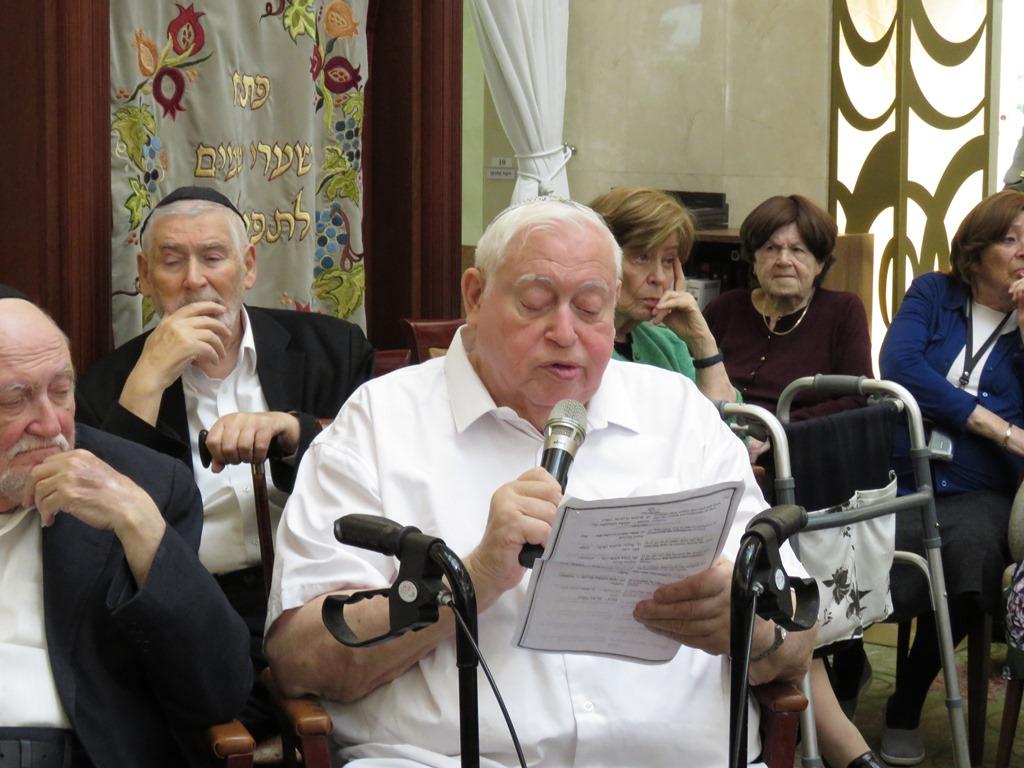
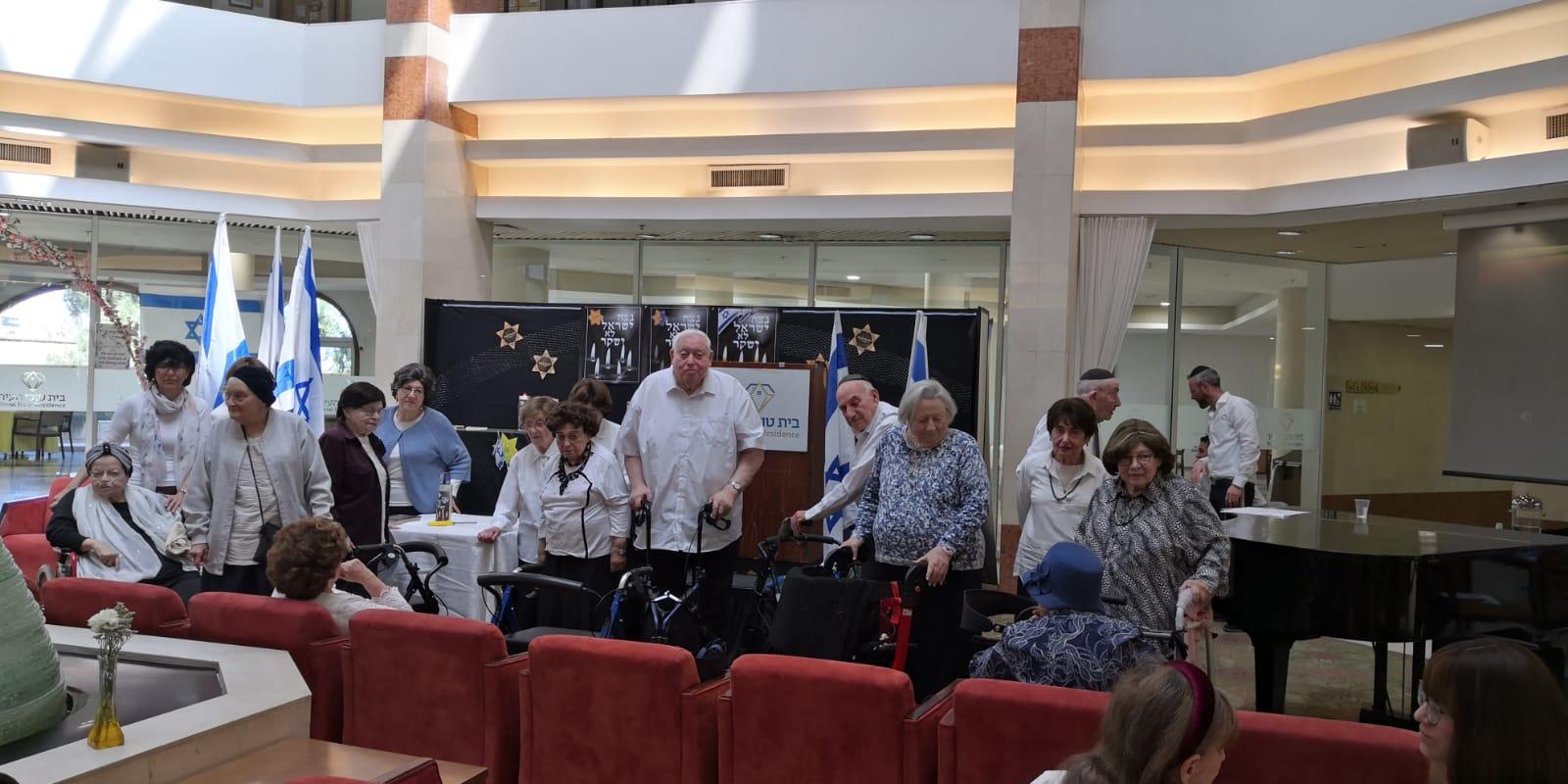
The annual Holocaust Memorial Day ceremony at Beit Tovei Ha’ir is always moving and meaningful. It was organized by the Cultural Coordinator, Yael Ben David, and social worker Yitzchak Cohen, bringing together the staff and residents of the sheltered living community to remember, to reflect, and never to forget the horrors of the Shoah.
The ceremony opened with prayers for the safety of soldiers currently defending Israel, for the swift recovery of the wounded, and for bereaved families. Yael reminded everyone, in the words of Israel’s President Yitzchak Herzog, that the six million Jews who were murdered represented one-third of the Jewish people before World War II. But despite that great darkness, faith did not disappear.
“We are privileged to stand today alongside Holocaust survivors who are living testimony to the strength of the human spirit, to faith that was not broken, and to the choice of life. They established lives and families, and contributed to the people of Israel and the Land of Israel. We honor them today.”
After the national two-minute silence siren, residents of Beit Tovei Ha’ir were invited to recite the prayers and light six memorial candles. Here are their stories.
Avraham Weiss was born in 1943 in Transylvania. Although his parents were forced into labor by the Nazis, and despite the pleas of her friends, his mother His mother courageously refused to give up on him, choosing life against all odds.
His parents were deeply affected—both physically and emotionally—by the horrors of that time, and since their immigration to Israel in 1950, Avraham has cared for them with great devotion.
Mrs. Erika Shulman was born in Budapest in 1941. When the Germans arrived, she and her family hid in a special closet, but they were tragically betrayed by their maid. Her father was sent to a labor camp, while Erica, her mother, and her brother were imprisoned. Through bribes, they managed to secure their release and spent some time moving from place to place in hiding.
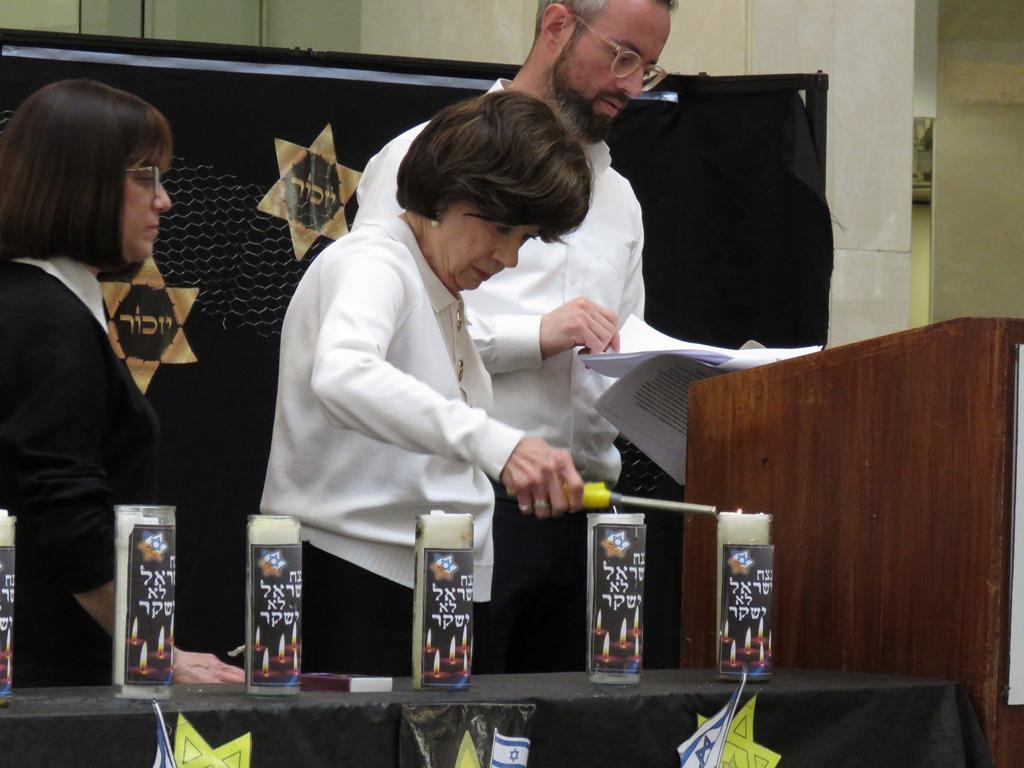 Erika remembers constantly feeling hungry, cold, and afraid. Eventually, they were rescued by the Swedish Righteous Gentile Raoul Wallenberg, along with Carl Lutz, and lived for a year in the Glass House – a protected building in Budapest that served as a refuge for hundreds of Jews under international protection – until they were liberated by the Russians.
After the war, they stayed in the Ainsbach displaced persons camp, established for Holocaust survivors awaiting resettlement, until an uncle sponsored the family’s immigration to the United States.
Elisheva Genizi was born in Újpest, Hungary, in July 1938. In May 1944, when Elisheva was not yet six years old, the Nazis began their takeover of Hungary. Many people sought ways to escape, one of which was the Kastner train.
The Kastner train was a special rescue transport organized by the Aid and Rescue Committee led by Rudolf Kastner. It successfully saved approximately 1,600 Hungarian Jews, with the promise of bringing them to Eretz Yisrael in exchange for payment. Elisheva and her sister were among the passengers on this train. Because Elisheva and her sister, Miriam, were so young, they were able to join a family traveling on the train without the need for separate visas.
They were taken to Bergen-Belsen, where they stayed for eight months in a special family camp. She recalls the suffering caused by hunger, yet she also vividly remembers the Hanukkah celebrations held there.
Afterward, they were transferred to Switzerland with a Youth Aliyah group. Elisheva remembers the snow and the counselors who had been sent from Eretz Yisrael. Later, the entire group traveled by train through Italy to Bari, where she boarded a British ship and sailed to Haifa. Remarkably, all of her family members survived the war and immigrated to Israel on Tisha B’Av 1948—each of them through an individual miracle.
Mrs. Necha Rosner, born in Poland, was only one year old when the Nazis invaded her town. Her father went into hiding, and her mother feared being left alone. Through the window, she saw the Jews of the town being gathered and loaded onto trains. After some time, her father returned home and said, “The town has been wiped out—no Jews remain.”
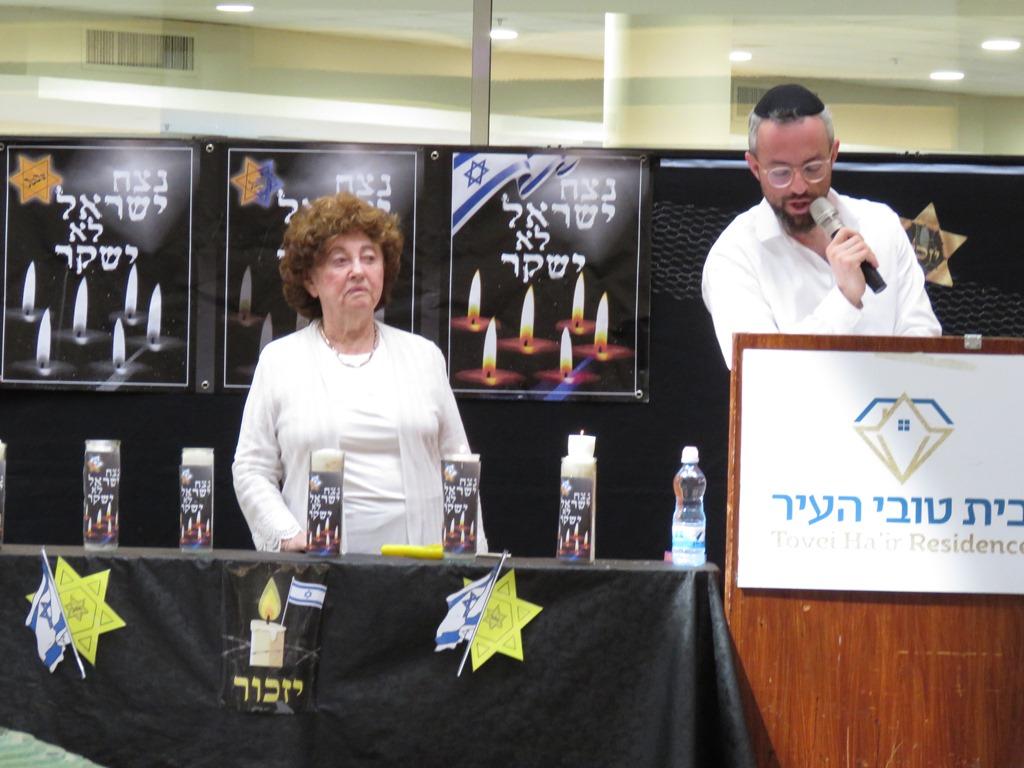 One day, all the Jews were called to a gathering point by the riverbank. The Nazi commander noticed Nacha’s father standing with his wife and two children: Nacha, a one-year-old baby, and her brother, five years older—alongside a cart carrying their few belongings. The commander ordered him to cross the river with the cart, saying, “If you make it—good, and if not—even better.”
The father knew the river well from his ritual immersions on Sabbath eves and holidays, so he knew exactly where the shallow parts were. He began to walk, but the Nazi noticed he was not following the intended path and shot at him. Her father fell, and her mother cried out. Suddenly, he appeared on the other side of the river.
Somehow, the mother and her two children also managed to reach the other side of the river, which was already under Russian control, where they reunited with the father. The family hid in the frozen forest and continued fleeing from place to place. After the war ended, the family was expelled from Russia back to Poland, and in 1950 they immigrated to Israel.
Rav Menachem Berkovitch was born in Hungary and sent to Bergen Belsen at the age of seven. He loved music and sought out any sounds of singing that he could find in the concentration camp. He found a chazan singing Keil Male Rachamim as Jewish corpses were being buried, so he stood there and learned the tune. He continued to sing this traditional prayer for the dead whenever he could. He was able to escape from a transport train, hide in the forest with the partisans, and make his way to freedom.
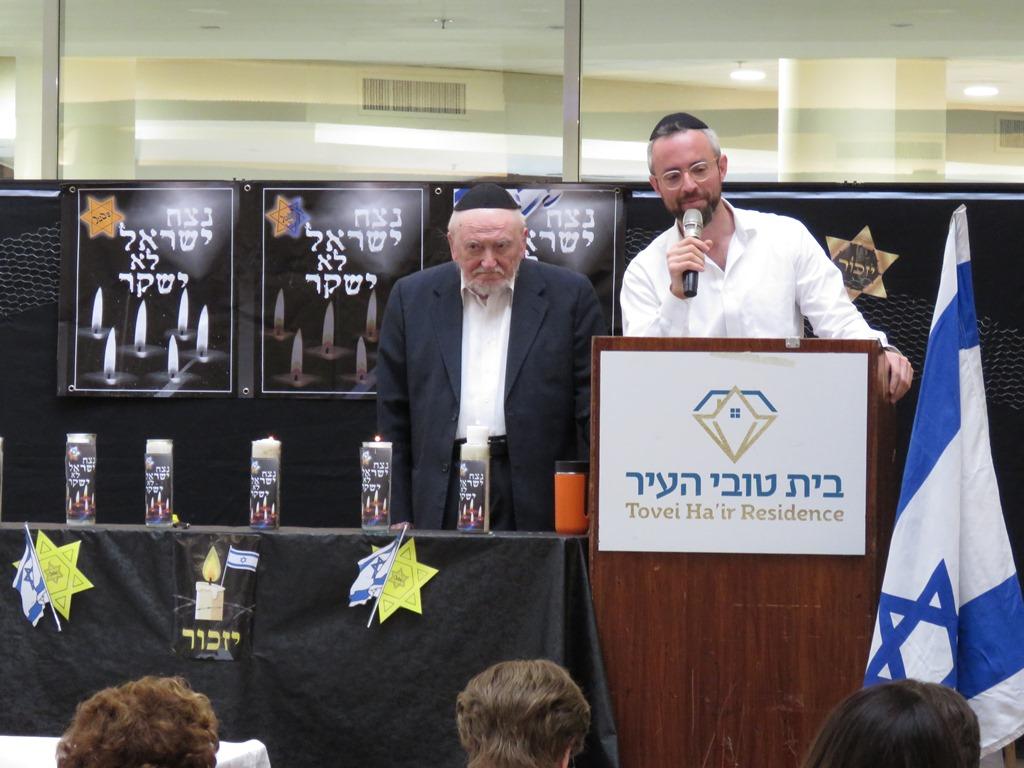
Honoring Second Generation Survivors
The 5th candle was dedicated to the second generation, the children of the Holocaust survivors, who grew up in the shadow of their parents horrors. Yael read a dedication written by Rabbi Lior Engelman describing their experiences.
To the children of that generation,
who absorbed the silences and did not challenge them with questions,
who heard, from their rooms, the cries of night terrors.
They grew up without uncles, without grandparents.
A generation that carried for many years the burden,
for what is their pain compared to the pain of their parents?
A generation that grew up to be good children, “normal” to the point of exhaustion;
Above all, to appear to be human.
They saw their parents hiding scraps of bread, living like servants in fear,
silencing memories and suppressing the horror.
They were not allowed to feel pain, to err, or to falter,
for upon their shoulders rested all the dreams.
To the children of that generation, who heard testimonies from grandparents,
yet could not imagine what their mother and father went through.
To that generation—thank you,you did something extraordinary.
Mrs. Esther Salomon spoke on behalf of the Second Generation – children of Survivors – living in Beit Tovei Ha’ir. She was born in Hungary at the end of the war.
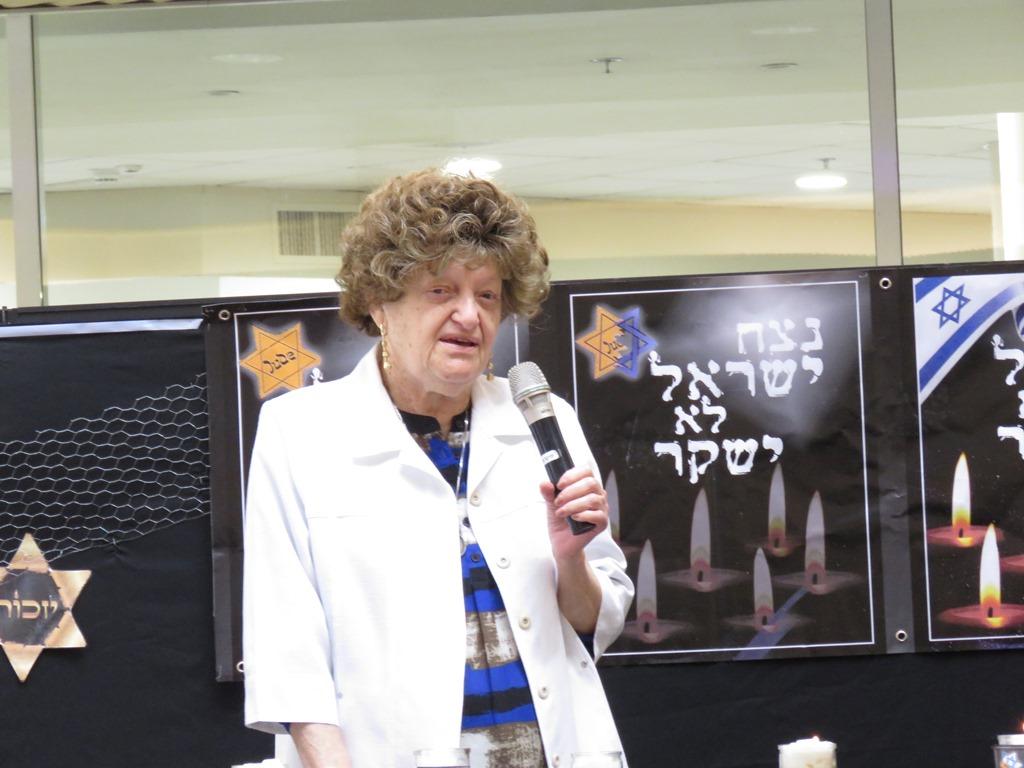 Esther’s father suffered an unimaginable tragedy, witnessing his wife and daughter being burned alive before his eyes and the eyes of his sons. Some of Esther’s brothers managed to escape and survive, while one One son remained devotedly by his father’s side, caring for him throughout the dark days of their imprisonment.. At the end of the war, her father weighed only 39 kg and was extremely frail; his son found a baby stroller and used it to carry his weakened father to safety.
Later, the father married the daughter of an acquaintance, a woman 23 years his junior, who was herself a survivor of Mengele’s horrific experiments. Miraculously, the couple had two children: Esther and her brother. They grew up in the shadow of the Holocaust and experienced a difficult childhood.
In 2026, there are currently 15 Shoah survivors living in Beit Tovei Ha’ir. Those who were able to do so were invited to step forward and light the sixth candle, honoring all of the Beit Tovei Ha’ir residents who are heroic Holocaust survivors. Despite their difficult experiences, they never gave up. They went on to build for lives of Torah and chesed, raising families whose existence can be seen as revenge on the Nazis who tried to wipe out our people.
Mr. Nechemia Kleinman recited Yizkor and Kadish. He was born in Tzoyzmir (Sandomierz), Poland. At the age of 12, he was deported to concentration camps, where he endured three grueling years of forced labor under unimaginable conditions. His tasks included shoveling coal for energy production and manufacturing ammunition. Through immense Siyata Dishmaya, he survived the brutal conditions of six concentration camps and the death march to Thereisenstadt.
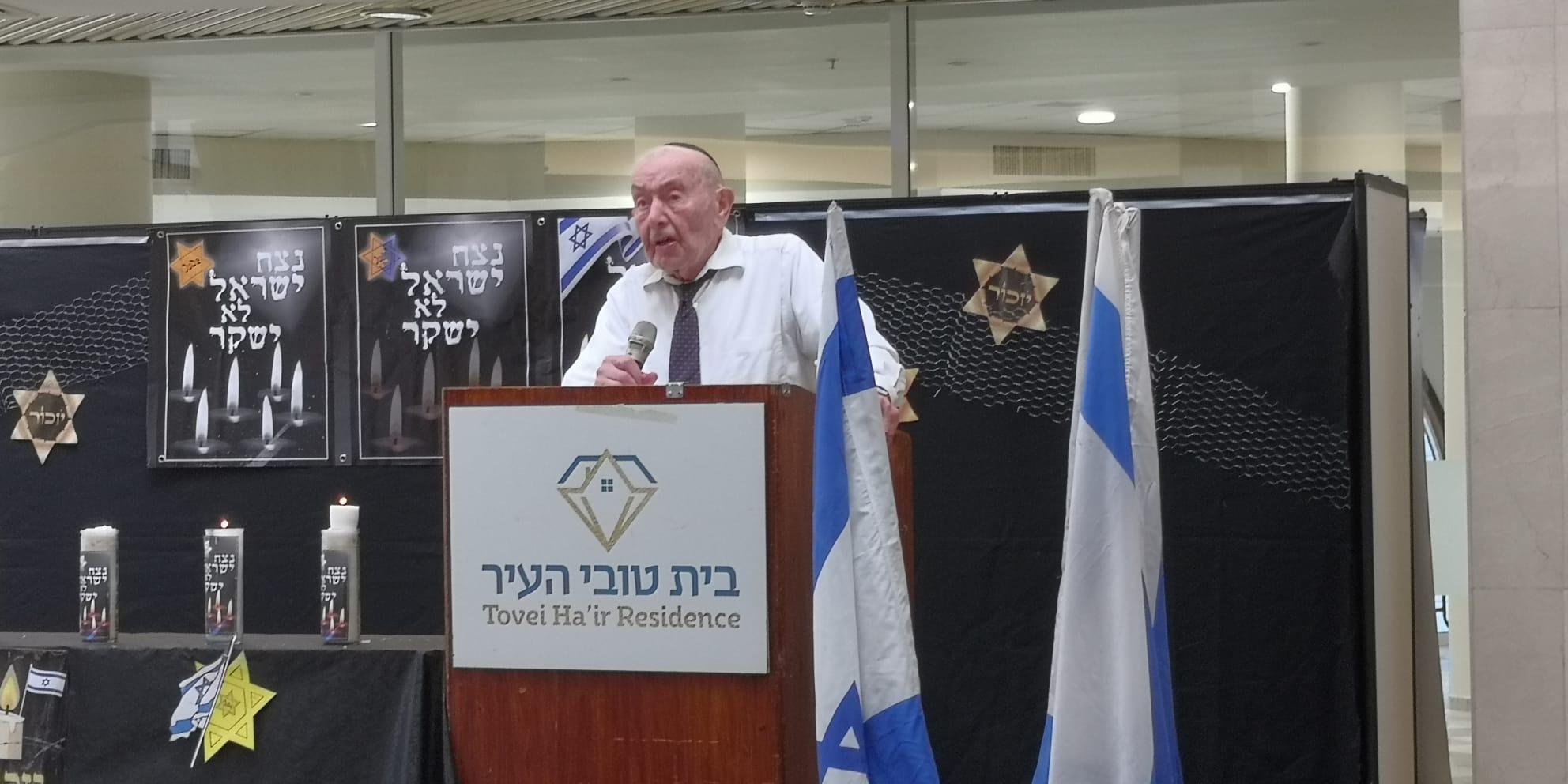 He was eventually liberated by the Russian army and brought to England as part of an initiative supported by the Rothschild family to facilitate immigration to Israel. However, due to the tensions between the Haganah and the British authorities, the group was prevented from continuing their journey. Ultimately, his uncle in the United States sponsored his visa, and he immigrated there.
The ceremony ended with the communal singing of Hatikvah and Ani Maamin. Five survivors went on to describe their experiences in more detail to groups of neighbors who gathered to hear their testimony. Among the audience was a group of social work students from a Haredi college, who came to see how Beit Tovei Ha’ir marks Yom HaShoah and honors Holocaust Survivors.
We feel blessed to have these Survivor heroes living among us, and hope that they will continue to inspire us for many years to come.